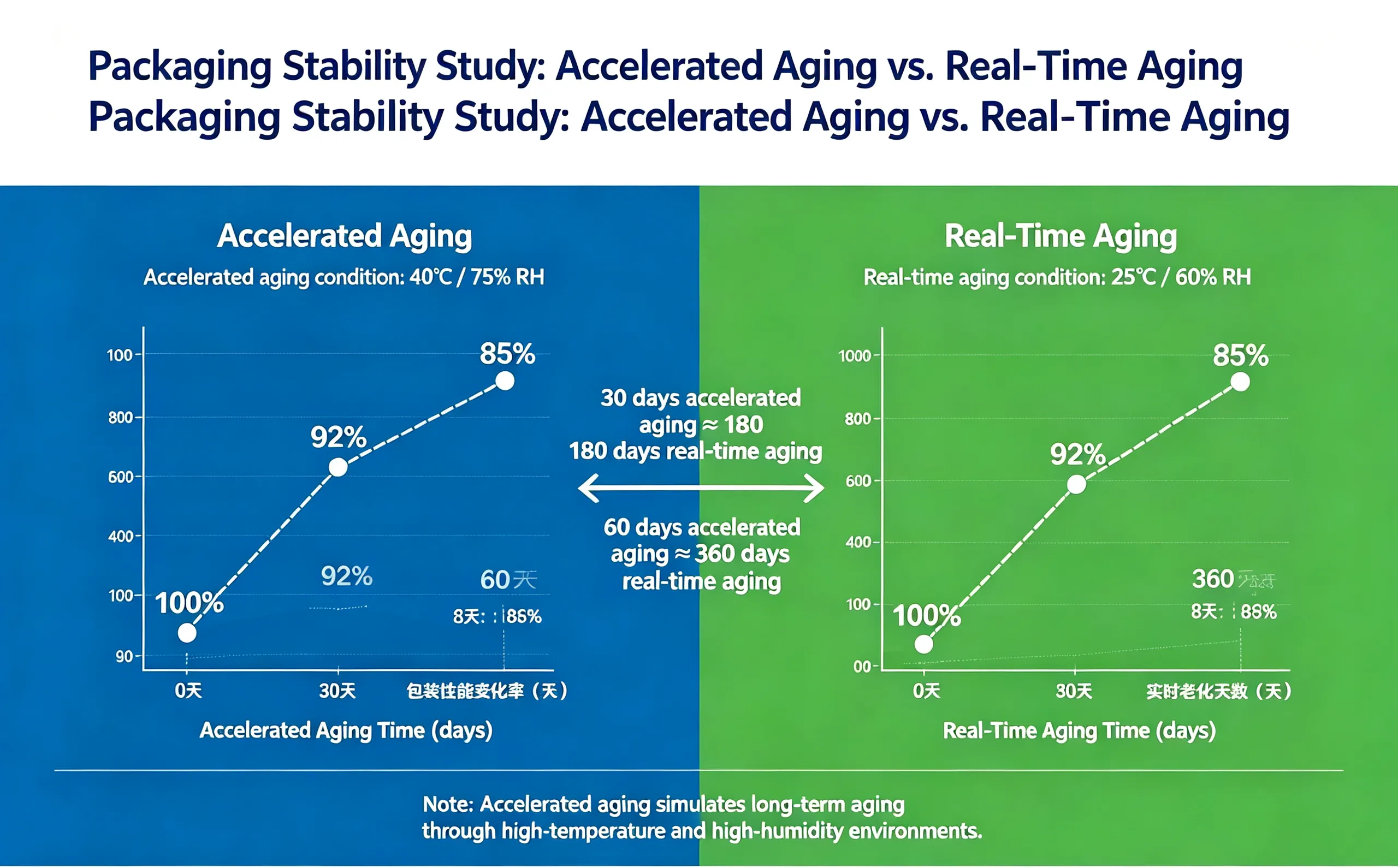
Earlier, we mentioned that switching suppliers requires "stability studies." Some readers asked: what is the relationship between accelerated aging and real-time aging? This article will explain it simply.
Earlier, we mentioned that switching suppliers requires "stability studies." Some readers asked: what is the relationship between accelerated aging and real-time aging? This article will explain it simply.
I. Why are stability studies necessary for packaging?Packaging materials experience performance degradation over time and due to environmental factors during their shelf life—sealing strength decreases, materials become brittle, and microbial barriers fail. The purpose of stability studies is to demonstrate that the packaging maintains its sterile barrier integrity throughout its claimed shelf life.
The core standard is ASTM F1980-21, "Standard Guidelines for Accelerated Aging of Sterile Barrier Systems and Medical Devices."
II. Two concepts to clarify:Accelerated Aging: Placing samples in a high-temperature environment (typically 50-55°C) utilizes the principle of accelerated chemical reaction temperature to simulate long-term storage effects in a shorter time.
Real-time Aging: Placing samples under actual storage conditions (typically 25°C) until the claimed shelf life is reached before testing.
III. The Most Crucial SentenceASTM F1980-21 Clause 1.4 clearly states: Accelerated aging data can be used as a provisional basis for shelf-life claims until real-time aging data is available; however, real-time aging studies must be conducted to verify the accelerated aging results.
Both must be initiated simultaneously, using the same batch of samples and the exact same test methods.
Key: If the conclusions of real-time aging and accelerated aging are inconsistent, the real-time aging data shall prevail.
IV. Key Parameters of Accelerated AgingASTM F1980-21's core calculation logic:
| Parameter |
Description |
Typical Value |
| Accelerated‑aging Temperature |
Recommended ≤60 °C, shall be lower than the material’s glass transition temperature |
55°C |
| Real‑time Temperature |
Upper‑limit storage temperature marked on label |
25°C |
| Q10 Value |
Multiplier of reaction rate for every 10 °C temperature rise; default value is 2 |
2 |
| Humidity |
Controlled for hydrolysis‑sensitive materials (typically 50±5% RH) |
Material‑dependent |
Accelerated Aging Factor (AAF) = Q10^((T_AA − T_RT)/10). At 55℃ vs 25℃, 1 week of accelerated aging ≈ 8 weeks of real-time aging.
⚠️ Note: The industry is currently debating whether Q10=2 is too conservative for room temperature conditions; specific projects should be verified in conjunction with material characteristics.
V. What to Consider When Changing Suppliers?
Stability studies for new packaging must be redone. If the material type remains the same before and after the change, three months of accelerated aging data can be obtained as a preliminary basis, but real-time aging must be started simultaneously and continuously monitored.
Only accelerating aging without real-time aging is a common issue requiring supplementary approvals.
In short: accelerated aging addresses the time lag issue of "whether it can be launched first," while real-time aging is the final criterion. Both must be done; neither is dispensable.