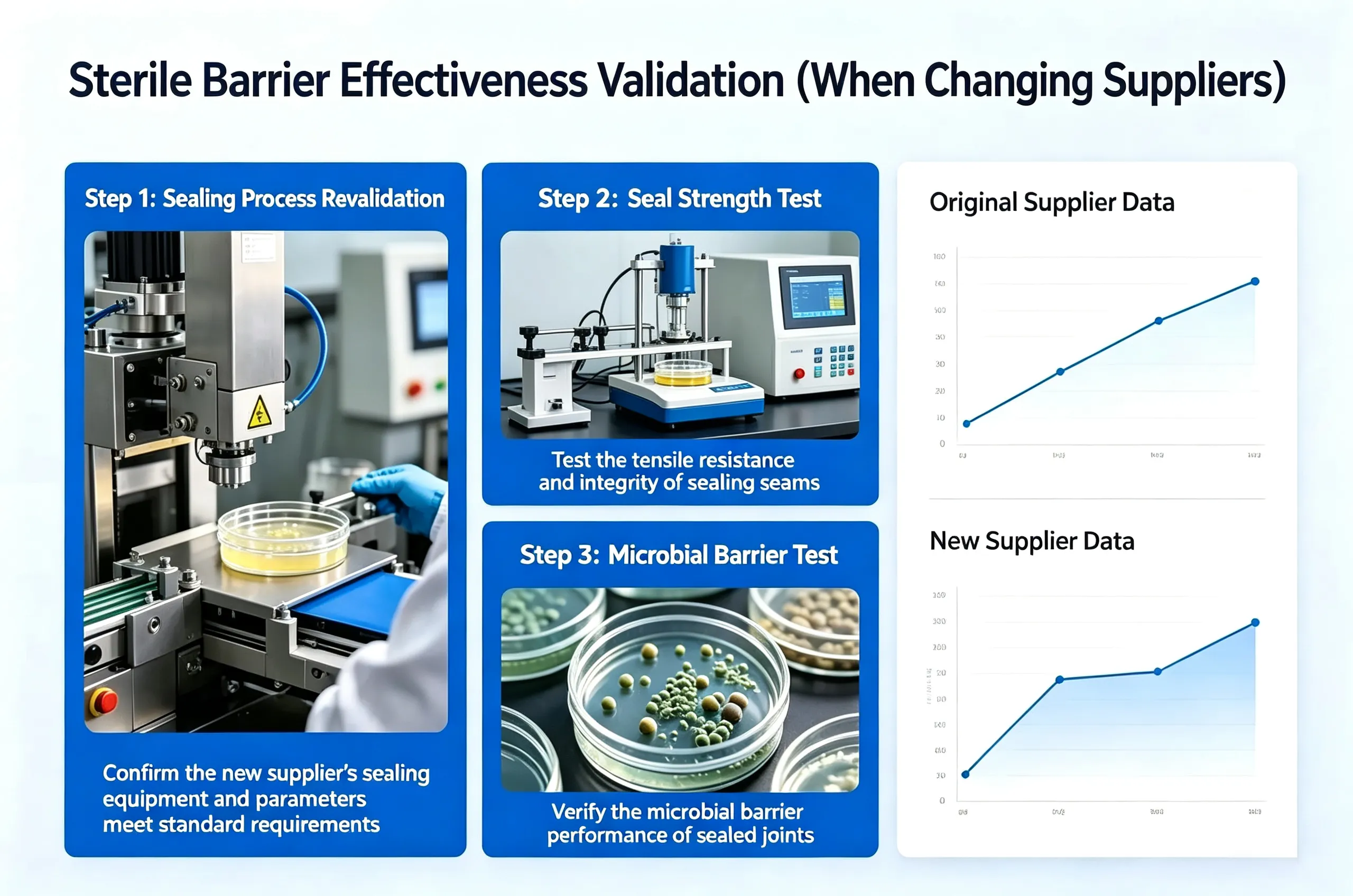
We previously mentioned that changing suppliers requires "sterile barrier effectiveness verification," which includes re-verification of the sealing process, seal strength testing, and microbial barrier testing. Parallel comparisons must be made before and after the change to prove that the new packaging's seal is not inferior to the original packaging.
This article will explain all three aspects clearly.
I. Re-verification of the Sealing Process After changing suppliers, if there are differences in material batches, grades, or coatings, the sealing parameters may need to be reset.
According to GB/T 19633.2—2024 (equivalent to ISO 11607-2:2019), the packaging process validation should follow a three-step process: IQ→OQ→PQ.
- Installation Validation (IQ): Ensure equipment is correctly installed and calibrated; key instruments have a calibration schedule.
- Operational Validation (OQ): Conduct test sealing within the upper and lower limits of temperature, pressure, and speed, with at least 10 samples per group, and locate the operating window.
- Performance Validation (PQ): Perform continuous operation under expected production conditions, with at least three production runs covering normal start-up and shutdown, shift changes, and material batch-to-batch variations.
Key parameters include: heating temperature, cooling temperature, sealing speed (or residence time), and sealing pressure. Alarms or shutdowns should occur if preset limits are exceeded.
II. Sealing Strength Test
How to test: Refer to YY/T 0681.2 (equivalent to ASTM F88), test the sealing strength at a peeling speed of (200±10) mm/min. It should be noted that this standard only specifies the test method and does not provide judgment criteria; specific thresholds need to be verified by the companies themselves. For blister packaging, the standard refers to YY/T 0681.12 (equivalent to ASTM F2029), and the consistency of the sealing process is determined by confirming the heat seal strength.
Judgment logic: Too low strength → the seal is prone to premature opening, and the sterile barrier fails; too high strength → the material tears and flakes when opened, contaminating the product. A reasonable approach is to set upper and lower limits to ensure that it falls within the range of "neither leaking nor breaking."
III. Microbial Barrier Test
Who needs to be tested: Breathable packaging materials—Tyvem, medical dialysis paper, non-woven fabrics, etc. Breathable materials themselves have a microporous structure, and it is necessary to verify that microorganisms will not penetrate them during long-term storage.
Non-breathable materials (PETG blister packs, aluminum foil composite films, etc.) inherently block microorganisms through their physical structure, and this test is usually not required.
Common methods:
- Aerosol method (ASTM F1608): Continuously attack the material with a bacterial aerosol to simulate the most unfavorable operating conditions.
- Contact method (ISO 11607-1 Appendix B): The material is in direct contact with a bacterial culture medium; observe whether microbial growth occurs on the reverse side.
IV. Parallel comparison before and after the change
| Step |
Action |
| Step 1 |
Take at least 3 batches of samples for both original packaging and new packaging |
| Step 2 |
Use the same laboratory, test method and acceptance criteria |
| Step 3 |
Compare the three test items one‑by‑one |
| Step 4 |
Data evaluation: results of new packaging ≥ original packaging (or both meet pre‑defined criteria) |
In short: When changing suppliers, you must re-verify the sealing process, seal strength, and microbial barrier. Perform parallel comparisons to prove that the new packaging is "not inferior" to the original packaging, and let the data speak for itself.